Do You Know What Shutter Speed Is Set on the Yashica Electro 35
Home Donate NewSearch Gallery Reviews How-To Books Links Workshops Most Contact
Yashica Electro 35
(1966-1977; GSN: 1971-1977)
© 2008 KenRockwell.com. All rights reserved.
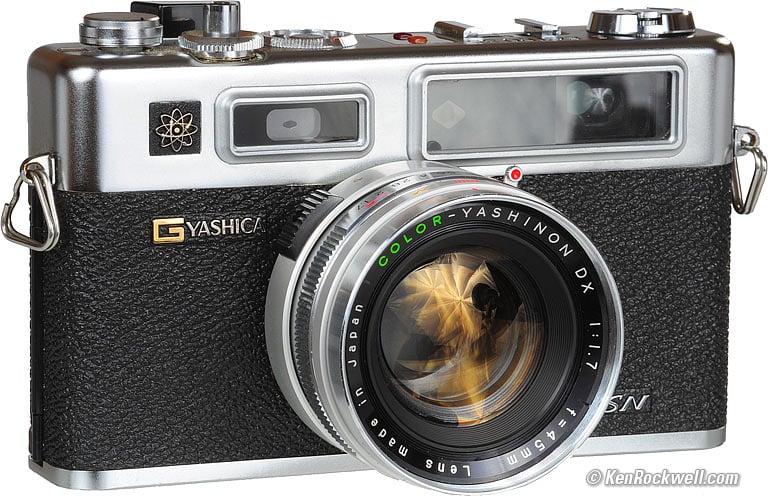
Yashica Electro 35 GSN. enlarge. This free website's biggest source of support is when you utilise these links, particularly this link directly to them at eBay, (see How to Win at eBay), and maybe at at Adorama. It helps me proceed reviewing these oldies when you get yours through these links, thanks! Ken.
September 2011, June 2008 Yashica Reviews All Reviews
Sample Images from fifteen September 2008
Not slap-up, but not atrocious from one 24-exposure roll of throw-away motion picture for a first try:
Mom and Katie
Sleeping Katie
Ryan and Crib
Mom and Fan Command
Ryan and Fan Control
Ryan and Fan Remote
Ryan at El Torito
Mom and Ryan at El Torito
Ryan and the Door
Ryan and the Door (cropped)
Ryan uses Dada'south Keys

Introduction
Intro History Specs Accessories Performance Usage Recommendations
The Yashica Electro 35 was one of the near pop consumer 35mm cameras of the 1960s and 1970s. My grandparents had i. They took it all over the world on their vacations, and came back with loads of great slides.
Anybody's grandparents had i. Yashica sold eight million of these in various versions over fifteen years.
The Yashica Electro 35 is a solid metallic camera. It has a big, clear viewfinder and rangefinder. It has a much clearer finder than the Nikon manual rangefinders of the 1950s that fetch astronomical prices from geriatric collectors.
The Yashica Electro 35 was designed for consumers, simply the great news for serious photographers is that the avant-garde features it had in 1966 are just what nosotros demand, and it doesn't have whatever of today's junk features that only go far the way.
The Yashica Electro 35 is an aperture-priority camera. Option your aperture, and the Yashica Electro 35 selects the shutter speed, from 1/500 up to xxx seconds or more!
It has a silent electronic leafage shutter. Information technology's quieter and and has less vibration than whatsoever of the clumsier focal-plane shutters of Leica and Nikon rangefinders, and no flipping mirrors like every DSLR.
The only gotchas are that the Electro 35 has no motorcar-exposure lock and it's an near all-auto camera. Information technology only has three manual shutter speeds, and that'southward stretching it. It is designed for a no-longer available mercury battery, however modern alkali metal replacements work fine.
This Yashica a solid metal photographic camera. It is a joy to bear around compared to my hulking Nikon D3, merely still has to be carried over-the-shoulder.
The Electro 35 has ever been inexpensive. In 1977 they sold new for $100, which is $350 corrected for aggrandizement in 2008. In 2008, they sell used for $5 to $20 at garage sales. A dealer will ask more.
It's solid and well-fabricated, but non as precise or equally fine as a Leica, or even equally nice as the less-useful Nikon rangefinders of the 1950s.
Since you lot're not looking through the lens, these cameras are especially useful for black-and-white and infra-ruddy photography. This is considering even with a dark filter on the lens, the finder remains clear.
History dorsum to top
Intro History Specs Accessories Performance Usage Recommendations
The Yashica Electro 35 was very avant-garde, existence electronic, when it came out in 1966. It was made though 1977, and sold at close-out until stocks ran out about 1980. Please notation the space-historic period atomic symbol on the front. The Yashica Electro is the Apollo of Japanese consumer 35mm cameras. (Of course I'm kidding; Japanese cameras take zip to do with the Apollo program. The official cameras are Hasselblad and Zeiss, while the Kodak Instamatic 104 was the official camera of the American people of that era.)
The only real differences over the Electro 35'southward xiv year run are that the offset models lacked a hot shoe and that the ASA ranges changed as films advanced.
| Color | Dates | ASA (ISO) | Hot Shoe | |
| Electro 35 | Chrome | 1966-1968 | 12-500 | no |
| Electro 35 G | Chrome | 1968-1970 | 12-500 | no |
| Electro 35 GT | Black | 1969-1970 | 12-500 | no |
| Electro 35 GT | Black | 1970-1973 | 25-one,000 | no |
| Electro 35 GS | Chrome | 1970-1973 | 25-1,000 | no |
| Electro 35 GSN | Chrome | 1973-1977 | 25-1,000 | Aye |
| Electro 35 GTN | Blackness | 1973-1977 | 25-one,000 | Yeah |
ASA Range: Motion-picture show got faster over the years. The only skilful colour moving picture in the 1960s was Kodachrome, which was ASA 10. As of 1970, ASA x Kodachrome was long gone but some super-speed films were faster than ASA 500.
Hot Shoe: "Hot" ways mod flashes connect automatically as you slide them in. In the old days, people used separate wink guns that used flash bulbs, so hot shoes didn't matter.
Specifications with Commentary back to top
Intro History Specs Accessories Performance Usage Recommendations
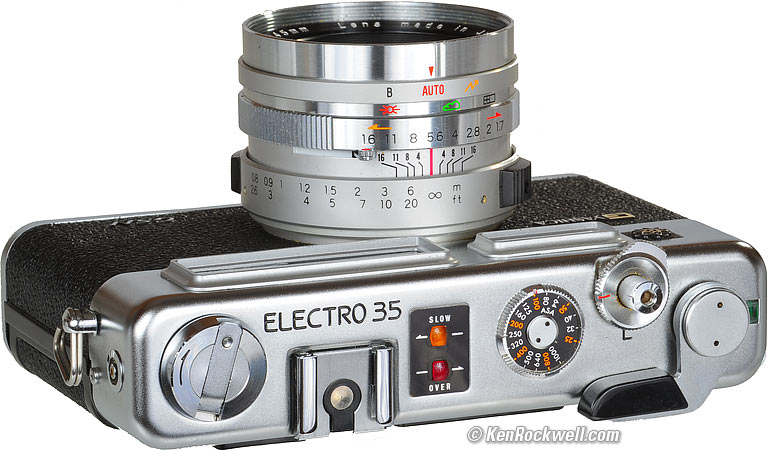
Top, Yashica Electro 35 GSN. enlarge.
Lens: 45mm f/ane.7. It'due south identical to an SLR lens. Yashica brands it equally YASHINON. " COLOR -YASHINON" was added in 1968 for marketing, since color flick was just starting to go barely affordable to amateurs. It's the same lens. " Colour " was a buzzword of the mean solar day as "Digital" is today. Think this is silly? How many of you lot pay extra for "Digital" filters?
Optic
vi elements in four groups, simply similar most every SLR lens.
Unmarried-coated in amber.
Diaphragm
five blades stopping down to f/16.
Filter Thread
55mm. (Optional 57mm skid-on hood.)
Close Focus
2.vi feet (0.8m)
Finder
Ever-vivid framelines lit through a split up window. Auto corrects for parallax.
Meter
CdS cell above lens, non TTL. You must compensate filters past setting the ASA punch accordingly.
Red OVER light means you're at ane/500 second or more.
Yellow Boring calorie-free means you're at 1/30 or slower; hold withal or use a tripod.
ASA Range (ISO)
1966-1973: 12~500.
1973-1977: 25~ane,000.
Shutter
1/500 ~ about thirty seconds.
Stepless electronic foliage shutter.
The slowest speed will vary with discontinuity: it can go longer than a minute at smaller apertures but simply iii seconds at f/1.seven.
Maximum Speed with Flash (sync)
1/500.
X-sync at all speeds, better than SLRs.
Ability
I PX32, E164, V164PX, TR 164, HM-4N, 4NR52 or 1404M v.half dozen Volt mercury bombardment.
Works with today'southward alkaline replacements. My Electro 35 has a 4LR52, EN164A, A32, PC164, TR164A, 1404A element of group i in it. These are made with 4 stacked LR52 or 640A-P cells in series.
The specifications for today'due south alkaline battery are 335 mAH, 25.5g, 17.1mm bore, 44.9mm height.
You can use a more common, smaller (170 mAH lithium, 150 mAh alkaline) PX28 if you lot jam in an actress spring and wrap the smaller bombardment in something to keep it centered in the Electro 35's larger battery hole.
The right PX32 costs just $9.99 and lasts twice as long every bit the wrong $viii PX28 that doesn't fit without a kludge, so social club ii PX32s and keep the spare handy so you won't have to pay $fifteen for a PX28 at retail if your battery dies.
Battery Check Light
Yes, also illuminates frame counter and can work as a small flashlight!
Current Drain
60mA while shutter is pressed and lights are lit or shutter is open up.
Less than 0.i uA when idle.
Size
six x iii-5/8 x three " (152 10 92 10 76mm) WHD, measured, including protrusions, excluding cap or example.
Weight
My Electro 35 GSN, fabricated in Hong Kong, measures 25.692 oz (728.4 1000) with total-size alkaline metal battery, but no instance, filters, caps or strap.
Yashica specifies 26.4 oz (750 m) without battery, which is heavier than mine.
Made in
Japan, or subsequently, Hong Kong.
The lenses e'er say "Lens Fabricated in Japan" fifty-fifty if the camera is made in Hong Kong. Hong Kong is discretely stamped on the bottom.
Accessories back to top
Intro History Specs Accessories Performance Usage Recommendations
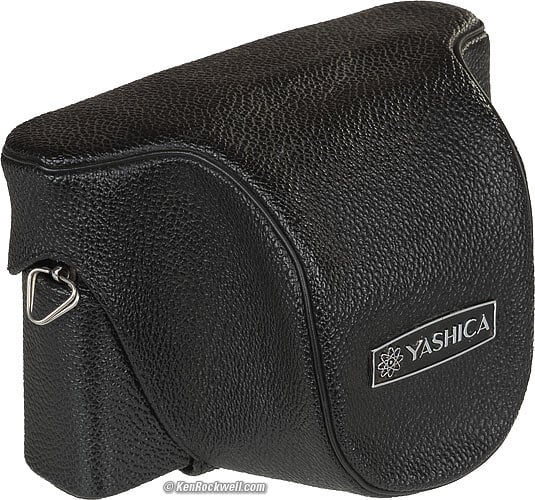
Yashica Electro 35 GSN in never-fix case.
Wide and Tele Lenses
Forget these. These were artificial "goggles" that screwed on the front end of the fixed lens, and but fabricated things worse.
These were awful because:
one.) They didn't really practice annihilation to alter the focal length. The "tele" was only 58.4mm and the "wide" only 37.7mm!
2.) Focus was a pain. They required several manual steps of measuring the subject altitude with the rangefinder, referring to a tabular array so resetting the rangefinder — for each shot!
3.) You had to compose through a separate finder which sat in the flash shoe, making you inable to utilise a conventional flash at the aforementioned time.
iv.) I think exposure was also screwed, with potentially weird restrictions and recalculations of the widest apertures.
Close-Up Arrangement
Yashica offered the usual close-upward lens and prism system. It lets yous shoot from 18 to 32 inches (45~80cm).
It is a close-up lens, and a prism which covers the viewfinder and rangefinder.
Yashica, using proper Japanese English, called this the "Auto-Upwardly Lens."
ST-7 Dedicated Mini-Tripod
This is an 8" (20cm) thing. The bottom screw of the camera example has cutting-outs which the users transmission champions as beingness uniquely dedicated to some nubbins on the tripod legs.
This pocket tripod was null special, but the Electro 35's low-calorie-free capability is. Y'all owe it to yourself to behave a pocket tripod for dark shots.
MS-20DX Flash
Yashica heralded this as "The Worlds Smallest" flash with GN 20 (meters, ASA 100). That'southward GN 64 in feet, ISO 100, or one-quarter the rating of the Vivitar 283.
It has a stock-still-output (manual exposure - no automation) and uses two AAs.
Yashica claimed that it was practiced for up to 40 shots on ane set of batteries, blazon unmentioned in the 1970s.
You much calculate the aperture by dividing the guide number by the field of study distance, and setting that on the aperture ring.
You tin can safely ignore this flash. Far more than useful is whatsoever flash with an AUTO setting.
Performance back to height
Intro History Specs Accessories Performance Usage Recommendations
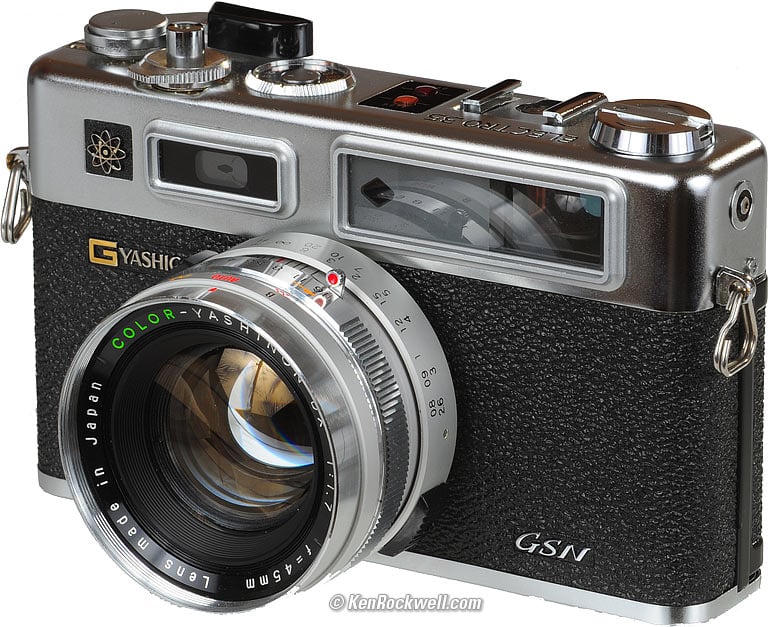
The Yashica Electro 35 GSN. overstate.
Overall
It's a expert photographic camera. It does what you need it to, and nothing more. The lens is fast and precipitous.
Information technology'due south fun, like shooting fish in a barrel to use and gives great results. It doesn't have any pointless features to get in the way.
The but serious shortcoming is the lack of an auto exposure lock or meaningful transmission settings. This means the only mode to recoup for backlight or bright or dark subjects is to tweak the ASA dial.
Ergonomics
The Yashica Electro 35 is easy to use. Zippo gets in the way, so long as you don't need AE lock. This lack of fluff simply lets me shoot and concentrate on my composition. Non worrying about anything else, like AF tracking or histograms, lets me concentrate on what matters: the picture.
The distance scales are both in black, which always makes information technology confusing trying to effigy which is meters and which is feet.
The red and xanthous OVER and Slow indicators are all I demand, and the colors and in-finder arrow directions are only perfect.
Rangefinder
The rangefinder is bright, abrupt and contrasty.
My shots are always in focus, even at f/ane.7.
Lens
The lens has the same functioning as any other fast normal SLR lens.
45mm is dead normal on 35mm moving-picture show. 50mm lenses are actually a bit longer than normal, even if they are more common. A "normal" lens is defined as having a focal length equal to the moving-picture show diagonal, which is 43.2mm on 35mm flick. Thus anything from 40mm to 45mm is normal, with 35mm lenses existence a bit wide and 50mm lenses being a flake narrow.
Sharpness
Just like all other fast normal SLR lenses, it'southward sharper than most people volition always be able to realize unless they are printing many feet (meters) wide.
It's a little softer in the far corners wide open, and much amend by f/2.8. This is as expected.
Coma
Coma is when vivid points of lite get blobs in the corners at night.
As expected, there is some modest coma broad-open, which is gone by f/2.viii.
Distortion
As most other fast normal lenses, in that location is only a tiny chip of barrel distortion.
Information technology is not visible unless you lot look for information technology deliberately.
If you exercise, dial-in +1.00 in Photoshop CS2's lens baloney filter to rectify it.
Metering
Metering is lower center weighted.
The metering arrangement is live and measures the light during the bodily exposure. An integrator counts off the photons while the shutter is open up, so if the light changes during an exposure, the Yashica Electro 35 compensates on the wing.
CdS cells don't respond to light very quickly, so this doesn't hateful much except for time exposures. If the lights all of a sudden come up, the Electro 35 volition cut a time exposure short to correct for information technology.
It works keen for negative flick. I haven't tried it jet with Velvia slides.
Meter and Shutter Range
Overall
The organisation changes ASA (ISO) with a window in forepart of the CdS cell. Electronically, the Yashica Electro 35 GSN has no idea of the picture speed. The metering range remains abiding in terms of exposure value (EV). The light values (LV) covered by the organization vary with film speed.
Vivid Light
The shortest exposure is 1/500. I'm curious if the metering system somehow tin't muster i/500 when stopped downward, since Yashica suggests an ND filter for beach and direct sunlight. I've had no problems with ISO 200 impress film in the directly California dominicus.
If and only if the Yashica Electro 35 can get to ane/500 at f/sixteen, that means the brightest EV covered is LV 17, perfect even for ISO 400 slide film in direct sunlight.
In the Night
Every bit tested, my sample Electro 35 GSN runs a maximum of near 3 seconds at f/1.7.
The electronics calculate time electronically as the lens is stopped down. The maximum time increases directly at smaller apertures to maintain the same total exposure.
| Discontinuity | Longest Exposure |
| f/i.vii | 3 sec. |
| f/2 | 4 sec. |
| f/ii.8 | eight sec. |
| f/four | 15 sec. |
| f/5.half-dozen | 30 sec. |
| f/8 | 1 minute |
| f/xi | 2 minutes |
| f/xvi | 4 minutes |
These all are equivalent to LV 0, which is a few stops short of beingness able to shoot under moonlight, only more than than enough for dark city streets at night.
Manual Exposures
The aperture is always set manually. That's the easy part.
Yous're on your own for the shutter. The merely real transmission speed is the flash position, which is i/30.
Let's exist generous and consider Bulb as another transmission speed.
Have out the battery, and the Electro 35 gratis runs at about 1/500.
Want manual exposure? You want a Canonet GIII QL-17.
Usage dorsum to top
Intro History Specs Accessories Performance Usage Recommendations
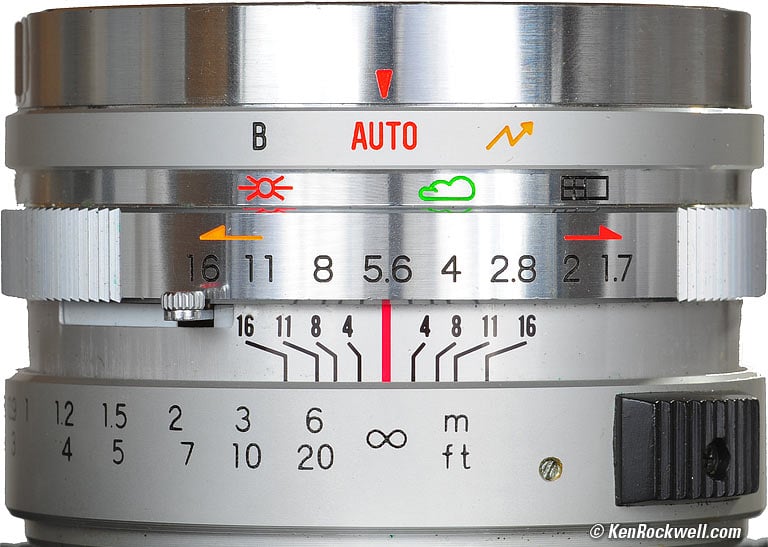
Yashica Electro 35 lens and controls.
General
It's easy for whatsoever lensman to effigy out. Press the Battery Check push, and the frame counter should light brightly in green. Green means Become, then load your picture show, wind to frame one, pick an aperture, focus, etch and shoot.
The carmine OVER and yellowish Tiresome lights are visible on the top of the camera for tripod use, and also announced as arrows in the finder. If you see the red OVER light, turn the aperture band in the aforementioned direction to make the lite become out.
If you see the xanthous Deadening low-cal, you'll get the correct exposure, but will need a tripod or a stone to insure a blur-costless shot.
The lights, if they are to appear, will announced ane-by-one as you press the long-travel shutter button. First the reddish appears, and so the xanthous.
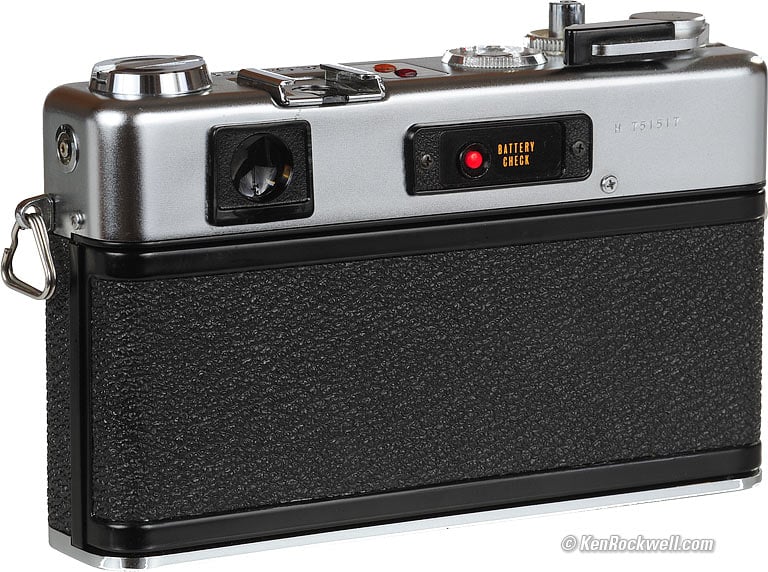
Yashica Electro 35, rear.
Battery-Check Light
The battery-check light lets yous encounter the frame-counter in the dark. It'south pretty bright, so y'all also tin apply it to observe your keys or signal for help on a deserted island!
Use with Filters
The meter doesn't await through the filter. Therefore you must set a lower ASA on the acme meter punch to compensate for the calorie-free lost past the filter.
Self-Timer
Gently rotate the lens' carmine-tipped lever (near the finder window) towards the lesser of camera. It buzzes mechanically subsequently you press the shutter.
Shutter Lock
Move the collar around the shutter push button to "50" to lock it.
Make full Flash
An reward of leaf-shutter cameras is that they sync with flash at every speed.
It's piece of cake to become balanced make full flash automatically in any light. Here'due south how:
1.) Use an "automated" electronic flash, like the Vivitar 283 or simply nigh anything.
2.) Choose the aperture at which you lot'd like to shoot and prepare it on the lens.
iii.) Select your fill ratio in stops. (Try one end for starters.) Ready your flash for an aperture this many stops smaller than the lens' setting.
Example: With a Vivitar 283 flash and ISO 100 picture show, allow's make up one's mind we desire to shoot at f/11. Set the Vivitar 283 to blue, which is f/8 at ASA 100. f/eleven is one stop smaller than f/8, so the flash fill up will be ane-terminate less than the ambient exposure. You lot may or may non also want to fix the ASA a little higher to compensate for the slight additional calorie-free of the flash.
Yashica's Tips
Don't wind the movie to the next frame, which cocks the shutter, if you're putting the camera away. It'due south all-time to leave the shutter uncocked. I've discovered that the meter won't activate when the shutter is uncocked; I don't know if this helps save batteries.
To shoot at ane/500 for action, turn the discontinuity band until the red arrow simply goes out.
To compensate the meter since there is no AE Lock, set an ASA one or 2 stops slower to lighten backlit shots. Since it's an averaging meter, if the frame bailiwick is generally dark with a smaller subject in the center, set the ASA one or ii stops college.
Yashica suggests an ND filter in bright light. I'yard unsure why, unless the meter and shutter range is somehow restricted at small apertures.
Recommendations back to top
Intro History Specs Accessories Performance Usage Recommendations
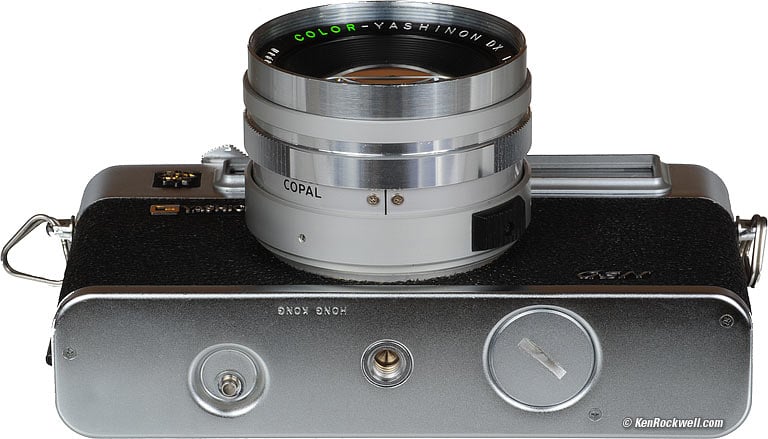
Bottom, Yashica Electro 35 GSN. Lettering on lesser says "HONG KONG," upside down.
Got garage sales? Got x bucks? Desire a sharp lens? Go i of these Yashica Electro 35s, preferably the newest GSN model, for its hot shoe.
If yous're a serious rangefinder pic shooter, this is an piece of cake camera to honey, but you'll probably prefer the greater flexibility of the Nikon 35Ti or Konica Hexar.
Alarm: Ever check for your lens cap. We paint ours day-glo orange every bit a prophylactic precaution. If you become out with your cap fastened, you can shoot dozens of rolls before you might realize it's on. The meter, viewfinder and everything except picture show taking work perfectly even with the cap on.
To run across an original advertising: accept a await at Modern Photography magazine, July 1966, page 36
Acknowledgement: Many thanks to Eric in Wisconsin of WorldDirectPromo.com, from whom this camera comes.
Help me assist you top
I support my growing family through this website, as crazy every bit it might seem.
The biggest aid is when y'all employ whatsoever of these links to Adorama, Amazon, eBay, Ritz, Calumet, J&R and ScanCafe when you lot get annihilation, regardless of the country in which yous live. It costs you nothing, and is this site'south, and thus my family'southward, biggest source of back up. These places have the best prices and service, which is why I've used them since before this website existed. I recommend them all personally.
If you find this page every bit helpful as a book you might have had to buy or a workshop y'all may have had to take, feel free to help me continue helping everyone.
If y'all've gotten your gear through one of my links or helped otherwise, y'all're family. Information technology's great people like you who allow me to keep calculation to this site total-time. Thanks!
If you oasis't helped yet, please do, and consider helping me with a souvenir of $5.00.
Every bit this folio is copyrighted and formally registered, it is unlawful to brand copies, especially in the grade of printouts for personal employ. If you wish to make a printout for personal employ, you are granted one-time permission only if you PayPal me $5.00 per printout or part thereof. Thank y'all!
Thanks for reading!
Mr. & Mrs. Ken Rockwell, Ryan and Katie.
Home Donate NewSearch Gallery Reviews How-To Books Links Workshops About Contact
evansbeekintiong41.blogspot.com
Source: https://www.kenrockwell.com/yashica/electro-35.htm
0 Response to "Do You Know What Shutter Speed Is Set on the Yashica Electro 35"
Post a Comment