Mentawai Tribe of West Sumatra Indonesia Art Photo Triba Campfire Dancel

The accolade-winning painter has gained fame for capturing the essence of life in the American Westward and the tropics — unlike versions, for him, of paradise.
As a kid growing up in Solana Embankment, California, Michael Cassidy was the self-reliant sort. As an acclaimed artist living in Curve, Oregon, he maintains some of that contained streak — and a certain casual philosophical bent. "I've never liked hurrying or desperate running for a buck," he says. "If I told you how many times I had the opportunity to sell a painting or brand a cadet and went fishing instead, you'd think ..."
You'd think, This is a guy who definitely paints to his own muse. "I embrace country sorts of values — any you run across in Mackay, Idaho, or Bondurant, Wyoming. Common salt-of-the-earth sort of stuff. I didn't capeesh these things when I was young, but now I do. People in those places would give you the shirt off their dorsum and would exercise annihilation to aid you."
His attitude informs his fine art. No airs here. In keeping with country values, Cassidy advocates a slowed-down, simpler life. All the meliorate to check in with the Big Inspiration in the Heaven for his painting. "Why would I spend all my waking hours simply to have a fancier whatever and as a result you're going also fast? God works at a different speed. When y'all're going slow and have no agenda, things can happen. You've got to be bachelor and willing. Y'all've got to inquire yourself, What'southward my value system? What am I chasing? Am I putting my energies into a harvest that will take a lasting value to it?"
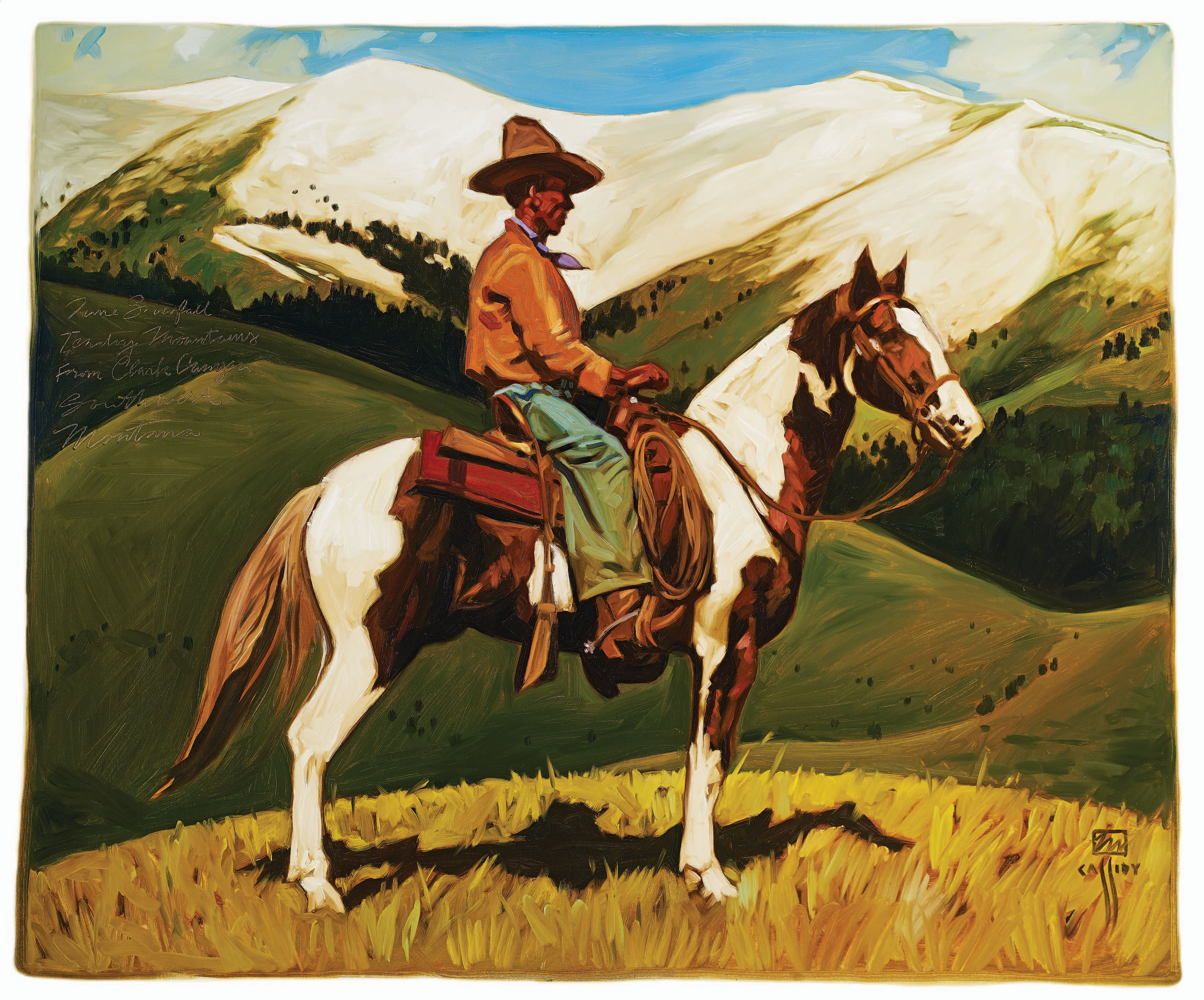
Currently among the about collectible in the Western genre, Cassidy this solar day is putting his energies into exploring concepts for new paintings by going through pictures he took final year on the Crow Indian Reservation. "We shot a couple thousand pictures. I do trips like that a couple of times a year, usually in spring and fall. Wyoming and Montana are beautiful, simply, boy, information technology's a long, cold winter and boiling hot in the summer. I like to go when there'south still a piddling snow on the peaks and everything is green. We'll take two-calendar week road trips and other shorter trips, like perchance fly into Albuquerque [New Mexico] and rent a automobile and drive from Santa Atomic number 26 into Colorado."
The paintings that come out of these travels are more than mere pictures on canvas. For Cassidy, they're zilch less than intimations of paradise. "I honey the idea that there's more than the hither and now. The value of art is that it's that signpost. ..."
A signpost people are willing to lay downwards good cash for. "It blows my mind the corporeality of money people pay for artwork, fifty-fifty mine, just I realize why they do it. Nosotros are all really looking for abode. People put a painting on a wall and it's a reminder. A painting is an platonic — a beautiful painting has this romantic allure and magic to information technology. Those are the characteristics of home and heaven. Nosotros see little indicators of information technology in those infrequent moments in our lives when we experience that it couldn't get any improve or more cute than this. They spend all this money to put it on the wall and are not even conscious of why. If through my painting I can make a relationship with someone, I have an opportunity to exist an influence."
In other words, to aid a dwelling hang a little heaven on the wall.
Cowboys & Indians: How did you lot get from South Pacific and surfing subject matter to cowboys and Indians?
Michael Cassidy: I was interested in the South Pacific and Indian horse civilisation from the time I was a kid. I was only born with those 2 master interests. I read everything I could get my hands on. As soon as I had a driver's license, I would go to the library at [Academy of California] San Diego and spend all 24-hour interval there looking at one-time books. I had some introductions to galleries in Hawaii from friends, and I did illustration work for Quiksilver, Patagonia, Hawaii Visitors [and Convention] Bureau, United Airlines, etc. I did a few covers for books on Indians but never brought whatever of my Western paintings to the marketplace until the last couple of years. Nosotros moved to Curve, Oregon, nine years ago, and since then the majority of my easel paintings are Western subjects. Information technology wasn't really a situation where I had a whole new subject area affair; it was more the fact that I had places in the West I wanted to go that are fairly close to where I live now.
C&I: Where in the West do you specifically like to travel for your creative research and bailiwick matter?
Cassidy: There are then many places, I wouldn't know where to begin. Anywhere y'all tin can meet the "basic" of the land is good. I avoid tourist areas and try and stay on the back roads as much as I tin can. I take more maps than you can shake a stick at. I look at Google Earth and try and encounter what the country is like, then curl the dice and become. You wouldn't believe where y'all can go in the West with a four-cycle bulldoze and a expert map.
I don't want to be too specific virtually my love holes, but I'll tell you virtually ane. A few years back I went past horseback upward into the West Elk Wilderness every year for a calendar week at a time with my buddy Steve Duffy, who's ane of the best falconers on world, and an old cowboy named Dellis Ferrier, who's been going into those mountains for 60 years, since he was eight years old, running cattle and guiding hunters. He knows more near that state than anybody live. One of the things that defenseless my eye was the old Ute trails y'all can however see. The white-homo trails zigzag upwards and down the hills; the Ute trails go direct upwards and direct down. Can you imagine what kind of horsemanship that took with no stirrups to stand in? It's really steep country. Their horses were extensions of their own bodies. In the time nosotros spent up there hearing Dellis' sometime stories and him showing us the erstwhile Ute camps and rustler'southward cabins, we never saw another human. Too steep and also long and as well remote a trail for anyone to hike. We rode every bit loftier as 12,000 anxiety. Just to find the trailhead was an adventure, and we knew the way! Really special place.
I spend a lot of time in the Beaverhead country in southwest Montana and eastern Idaho. It'southward beautiful land and sparsely populated. Nobody really goes up there because information technology'due south not on the way from i place to some other and there'due south no tourist spots. I like empty country. Northern Nevada is dandy. Maynard Dixon country — I like the Sangre de Cristo Range in southern Colorado-northern New Mexico. Anywhere in New Mexico is great. I like the Upper Green River area on the w side of the Winds. That was mountain man country. I reread Osborne Russell'southward Periodical of a Trapper last year while we traveled the surface area. I like to read the history books, get a map, find these places, and and so get there and explore. I end at ane-equus caballus towns, quondam graveyards, battlefields, historical markers, etc. Me and my manager, Pete, are road dogs. We bring expert cigars, some single malt scotch for the campfire, and look for visual golden nuggets and any is effectually the next curve.
C&I: What attracts you to Western and Native American culture?
Cassidy: What information technology represents. The story. Man was made with a thirst for beauty, romance, adventure, and beloved. The cowboy and Indian lived in a land that humbled man. There's a lot to be said for that. Humility is the showtime of wisdom. They saw dazzler a lot more oft than about of us do today. Just living in those times was an adventure on a daily basis. Read mountain man Osborne Russell'due south Journal of a Trapper for a little gustation. They had a different prepare of values than the popular civilisation represents today. God, family unit, and moral values were more of import. Lookout man whatsoever onetime western. There'south always a moral to the story. They needed religion to survive and scratch a living out of a harsh state.
I adore the way the Plains tribes fought for their way of life. Liberty meant everything. How many people today are willing to put their life on the line for a set of principles? The old-fourth dimension cowboys and Indians were hard, tough, cocky-reliant people. Their word was their bond. They were humbled by a land they knew was stronger than they were. They knew there was something or someone greater than themselves.
There'due south a reason that cowboy and Indian culture withal resonates with people. They recognize a set of values that stays the aforementioned no matter what changes in popular culture. In my opinion, our modern culture is running down — too much time in front of the Boob tube or with our faces in a prison cell phone. The values those one-time-timers had aren't "old." About of us in "flyover country" even so have them. I paint the West because I believe in what information technology represents.
C&I: How do you go about making certain you get it correct?
Cassidy: I do my homework. Lots of research (reading, old photos, etc.) to start with, and so I go and visit the people and places I want to paint. I spend a lot of time on the road. You take to spend the time to effigy out what the essence of the story is. Sometimes that can take years. I've lived in Oregon for nine years, and I'm still trying to figure out what the story is. What makes information technology unique? I think I understand Montana, Wyoming, etc. Oregon I still oasis't figured out. It takes some thinking and looking effectually until you stumble on something that speaks to you lot. You merely have to put in the time and the miles.
C&I: Y'all've painted a off-white corporeality of surfing, and you're a surfer yourself. What, if anything, practice surfers and cowboys accept in mutual?
Cassidy: Surfers learn pretty quick that the ocean is a lot more powerful than they are. If you don't respect it you get an ass-boot (actually, you get that anyway). When the surf is actually big, they say there are no atheists in the affect zone. Everybody prays when they get caught inside. Well-nigh-drowning is not fun. Surfers are observers of nature like a cowboy or an Indian. When a city person goes to the beach, they see sand and h2o. A surfer knows what the tide is doing, the wind direction, how large the peachy is, what management information technology'southward coming from, whether the storm generating the nifty is close or far away, etc. Most of this they know at a glance. Extrapolate that to what a cowboy or an Indian knows about their own country. Country people sit still long enough to watch and learn. City people don't sit all the same. Modernistic civilisation doesn't sit all the same. Both surfer and cowboy are gluttons for beautiful places at the edges of civilization. They're awed by that beauty, and it refreshes their soul. They like to run across what's effectually the next bend and share the take chances with a friend.
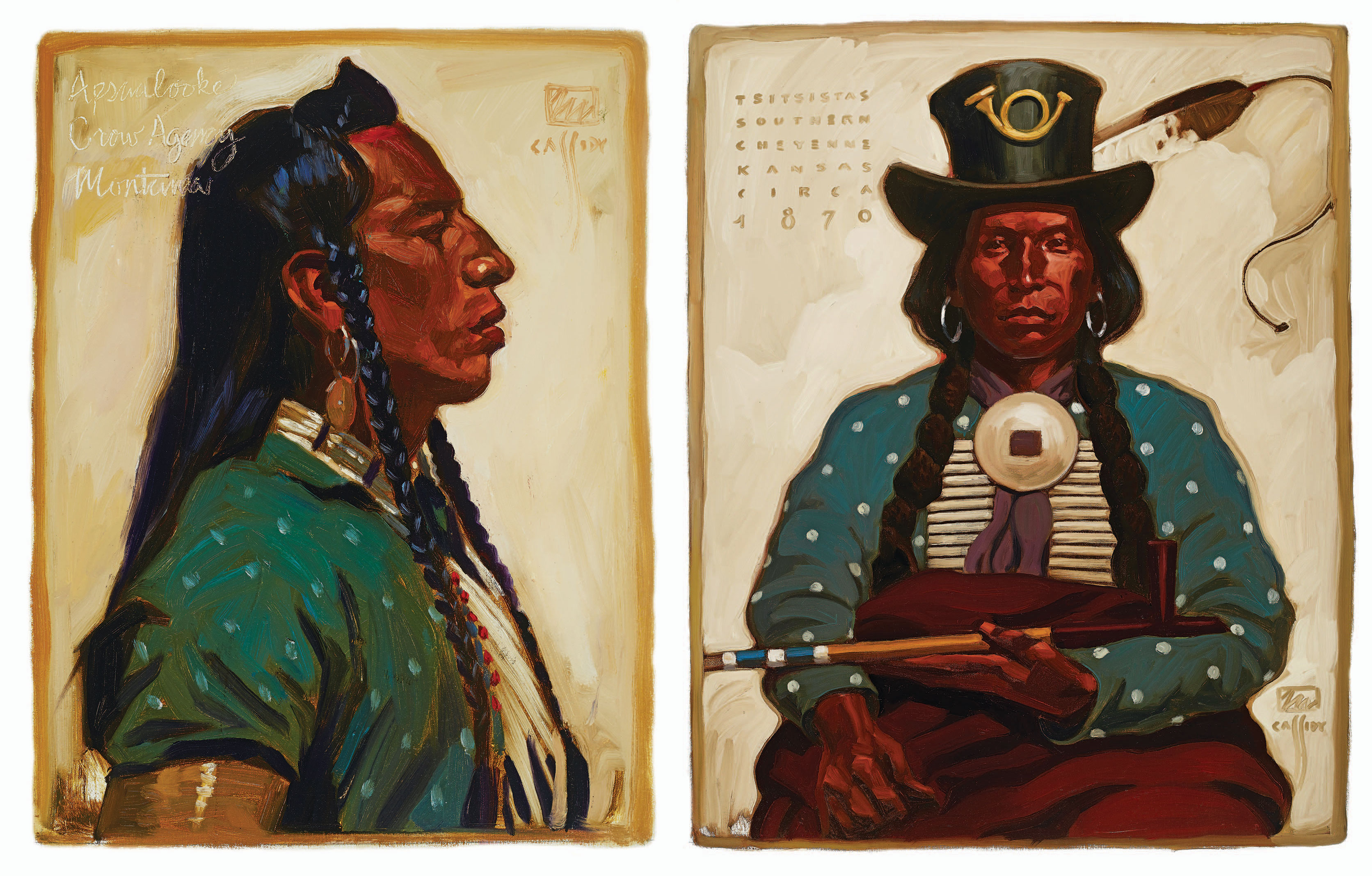
C&I: Both Native Americans and Pacific Islanders have provided you with rich subject field thing. Whatever similarities there?
Cassidy: Any people I've ever met that live in a place where nature dominates human have many of the same characteristics. They take a slower pace of life. They're more family-oriented. Experience is more than important than material goods. They share whatever they have. There's commonly a spiritual attachment to the land. Nobody is in a rush. There's fourth dimension to think. That appeals to me. I choose non to live at the speed of modern times. Less is more. Slow downward — you learn more.
C&I: What specific tribal cultures attract you?
Cassidy: Different tribes for unlike reasons. The Sioux and Cheyenne for their willingness to fight for their country fifty-fifty though near realized they couldn't win. The Shoshone and Flathead for the wisdom and prescience to brand the pioneers their friend and not an enemy. No Shoshone or Flathead ever killed a pioneer. The Flathead were a very chaste and cocky-disciplined people. I spend a lot of time in the country where they lived. The Comanche for their horsemanship. Certain personalities I find interesting. Washakie, for example, lived 100 years from [near] 1800 to 1900. He ruled the Shoshone for more than than 60 years. Virtually tribes didn't have a head principal that everyone followed. When he was most 70, some immature Shoshone braves were lament most the idea of ending intertribal warfare (which was how they earned their status in the tribe). Some of them called Washakie an old woman. He said naught and then left camp for two weeks. When he returned, he dropped a half dozen Sioux scalps at the anxiety of his detractors without a give-and-take spoken. [At] 70 years sometime. All criticism stopped from that moment forward. Some other time, Washakie dealt with a domestic violence issue by a Shoshone man who was beating his wife by just walking upward and shooting the offender in the head. He told the reservation minister who had made him aware of the problem, "You no worry. He no problem no more. I fix him." The Sioux said Washakie was the single greatest warrior they always fought. Not a whole lot of attention is paid to him, just what a story. He lived through the unabridged 1800s and saw it all.
An interesting footnote to this is that those tribal members who know will tell you that private tribal characteristics — some for better, some for worse — nevertheless exist. [They're the] same characteristics now every bit back in the old days. I've heard some actually funny and really crazy stories I tin can't repeat. Suffice it to say, people are people wherever you go.
C&I: Do western movies influence your work?
Cassidy: I think like anybody else I've been affected with a romance with the West that in part comes from westerns. I like the fact that the old westerns always had a moral to the story. I'll spotter whatever western with Robert Duvall in it. He just gets it. Lonesome Dove was probably my all-time favorite. I like the old spaghetti westerns even though they were fabricated in Spain. What's odd is that the music for those movies and old-time surf music are most identical. There was a made-for-Tv movie chosen The Skilful Onetime Boys with Tommy Lee Jones. He does a classic West Texas cowboy as adept as it could be done. Wish I could get my hands on it. [Annotation: The motion-picture show is manufactured on demand when ordered from Amazon.com.]
C&I: Your biography mentions surfing, travel, faith, and family unit equally your touchstones. Tell us more nearly that.
Cassidy: Surfing. There'southward nothing quite like it. Y'all're riding a band of energy that moves through the h2o generated by air current that's come hundreds of miles beyond the bounding main to intermission on the reef y'all're floating over. It takes years to learn to do well. If you didn't start as a kid, your chance of getting actually good at it is very slim. The fact that many of the best waves in the world are in drop-expressionless beautiful locations far from civilization makes it magical. I've ridden waves in the Mentawai Islands off Sumatra [in Indonesia] with Rock Age tribesmen paddling canoes in the aqueduct. Surfers are traveling fools. They will go anywhere no matter how remote if there's skilful surf to exist had. The adventure is half the fun. If the surf is skillful, it's gravy.
Travel. I've been so enriched by the people and places I've been blest to see. It would take a book to describe it (actually, I'm working on one called Eden). You prefer whatever y'all see that'south adept into your own lifestyle. I wish young people had the same opportunity I had to travel. Yous acquire much more than you lot would e'er learn in a classroom and brand lifelong friendships. My lifestyle is an amalgamation of all those places. I'm office Hawaiian, part Fijian, part Mexican, role cowboy, etc. That's real wealth to me.
Family unit. The Hawaiians have a thing chosen ohana. Information technology'south extended family. It's based on relationship, non blood. As a result, I have a huge family and family unit members all over the place. At home I have my kids and a loving married woman who puts up with my wandering without complaint. She's learned to practise faith in God existence married to an creative person. Y'all never know where the next paycheck is coming from. They say God is never late but rarely early. When things are tight, that's the time to give. It'southward the opposite of mutual sense, simply it works!
When y'all travel through the small towns I frequent, the further you lot become from the big city, the more you come across how important family is. The simple things in life matter a lot more. I alive in "flyover country." God and family are important hither. Present that makes y'all a rebel in the eyes of the pop culture. You're mocked as a Bible-thumper or bigot or "bitter clinger." A dumb redneck. Of course none of it's true. People thought the same thing about cowboys and Indians in their twenty-four hours. Whatever way the popular culture goes, I tend to get the opposite manner. I'll follow the truth wherever information technology leads, whether it's popular or not — no apologies.
Faith. I appreciate your asking the question. Almost people avoid information technology like the plague. They'll talk about anything except what really matters. Every bit regards religion'due south relationship to art: God made me an creative person. I'll be ane for eternity. This is but the beginning of forever. I'm even so a trivial child in that regard. In that location'southward so much to acquire, so many stories to tell. I realize that what an creative person does is really rough in comparison to the 3-D ever-changing canvas that God paints every 24-hour interval, but he finds a fashion to employ it. I believe the reason I'm a painter is to call attending to what God's made and the signposts to heaven they represent. I can participate in the process of honoring him. He didn't have to do that, just I'yard glad he did. He fabricated us creative beings. It's mind-blowing when yous actually retrieve well-nigh it. At that place are and so many stories to tell you lot couldn't fit them in a thousand lifetimes. I have and so many projects I'll never get to in this lifetime. There's never any reason for me to be bored or without inspiration. God provides.
C&I: It's a wonderful philosophy. Where in all that does paint actually run across canvas? What's your studio like?
Cassidy: Information technology's the whole second flooring of my firm. I have a lot of room. Brusque commute. I work when the kids are at school or at dark after they go to bed. It'south peaceful at night. There'southward an function, a stereo, Ping-Pong table, pool tabular array, a printer and computer, etc. Information technology'due south nice to be home where I can be with my family when I need to. I decided early on when my son was born that I would never tell my kids I couldn't play with them considering I had to work. Family comes before work. The older I get, the more I simply want to paint. The last couple years have been my most productive to engagement.
C&I: Who are some of your teachers and inspirations?
Cassidy: John Vocalizer Sargent and Joaquín Sorolla were inspiring for their technique — in my opinion the two best with a brush that ever lived. I like W.H. Dunton, Victor Higgins, and Ernest Blumenschein from the Taos school, and Maynard Dixon for the spiritual feel for the land that he had. I loved the analogy work of Maurice Logan. I like John Moyers' work.
Every bit far as a literal teacher, the near influential was "Cowboy" Doug Durrant. He was a drawing and painting teacher at Palomar College that knew everybody from Sonny Barger to the governor of Texas and everybody in between. He spent his summers in Alpine, Texas, driving the dorsum roads, sketching in the daytime and shooting puddle in the honky-tonk at night. He just had soul. That was the thing he taught me: Discover out what the essence of something you love is, learn about it, and pigment that. Pay your dues and tell the story in your phonation. He was a proficient friend. He came to my wedding ceremony and my gallery openings. He was a champion of young artists. He retired last bound and passed abroad terminal fall. I miss him, simply I'll see him on the other side.
C&I: Do you lot abide by the philosophy that fine art should carry the message of the creative person? What are you hoping to communicate?
Cassidy: I do. It'south important that an artist have a story to tell that has their postage stamp on it. Yous have to find out what that story is first; otherwise you lot're just making a ornament. I think we have a story written in the states from birth. It's not, however, immediately apparent. It takes fourth dimension and the experience of just living life to bring information technology out. You might exist born with a gift for art, but that's just a modest piece of the pie. At that place's big chunks of hard piece of work, stubborn decision, and self-subject area you lot demand for it to fully blossom. Most people aren't willing to do all that. They desire information technology all now. Information technology doesn't piece of work that way if you really want to brand the nigh of what you've been given.
I finally figured out that my obsession with the South Pacific was an endeavour to observe heaven on earth. Information technology's a Garden of Eden affair. Information technology took years to effigy out there is no paradise on earth. I went to a lot of places. They all accept fatal flaws — namely that you don't go out alive. It always ends. Everybody is somewhen required to cheque out.
What really matters is what the symbols of paradise stand for, where they bespeak. Abode. Sky. You see the story of earthly paradise lost in a Tahitian daughter'south eyes. You see information technology in the faces in the old photographs of Sioux and Cheyenne. Nosotros know we're made for paradise and we desire it with all of our beingness. The truth is that what nosotros see with our optics is temporal. It's what we don't yet see that's really "real." The Indians understood this. That's why they weren't afraid to dice. The cowboy humbled before nature sensed information technology. This isn't dwelling. It's a hotel stay, if you will, but we see the signs of what's to come in those magic moments in life that come all as well infrequently. The more you go out looking for them and ho-hum downwards long enough to see them, the more than frequent they become. Cowboys and Indians saw magic all the time. To capture a small glimpse of that magic on a sheet is what I hope to do. If I can movement someone to contemplate the things that final, the stories that never die, then I did my job.
Read more of the interview with Michael Cassidy.
From the Baronial/September 2016 issue.
0 Response to "Mentawai Tribe of West Sumatra Indonesia Art Photo Triba Campfire Dancel"
Post a Comment